Purged k-fold and CPCV
How do purging and embargo prevent overlapping labels from leaking across folds?
Remove training labels whose outcome intervals overlap a test interval, then embargo the adjacent period required by the horizon. CPCV combines several chronological test groups; its illustrative paths and the documented ML workflow need executable verification before claiming app support.
Published validation methods do not prove these Stochastly nodes execute correctly in a graph; the graph effect must be tested before availability claims.
Financial labels can use future bars. Purging removes training labels that overlap test labels; an embargo excludes nearby observations after a test block.
Why ordinary folds leak
A sample dated before a test fold may still have a label ending inside that fold. Training on that label exposes part of the test outcome. Purged k-fold removes overlapping label intervals from training. An embargo creates an additional separation after the test interval for features with serial dependence.
An interval check
Suppose a test block covers bars 10 through 19 and a training label starts at bar 8 but ends at bar 12. The intervals intersect on bars 10 through 12, so that row is purged. With a two-bar post-test embargo, candidate training rows at bars 20 and 21 are excluded too. The exact interval boundaries must follow the label definition.
Purge train label i when [start_i, end_i] intersects a test-label intervalCombinatorial paths
Combinatorial purged cross-validation (CPCV) selects several test groups from chronological blocks, purging and embargoing each split. With six blocks and two test blocks per split, the number of test combinations is 6! / (2! × 4!) = 15. The method yields multiple out-of-sample paths, with dependence between paths that reuse observations.
Number of combinations = n! / (k! × (n - k)!)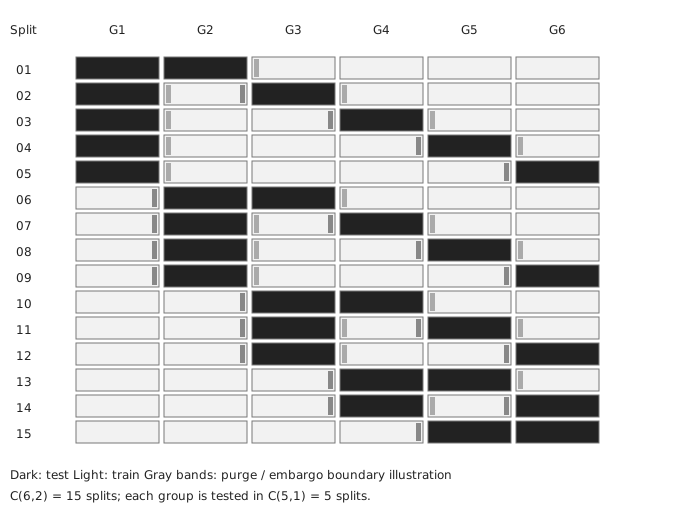
Related but distinct CSCV
Combinatorially symmetric cross-validation (CSCV) ranks an in-sample winner against other candidates out of sample to estimate PBO. Its symmetric half-splits answer a selection question. CPCV adds label-aware purge and embargo to a model validation scheme. The documented ML walk-forward design includes a horizon-aware embargo, while the documented PBO design uses CSCV splits. Executable graph behavior and its effect on output need separate tests before either is presented as an available workflow.
Frequently asked questions
What does purging remove?
Training observations whose label intervals overlap a test label interval.
Is an embargo a substitute for purging?
No. Purging checks label overlap; embargo excludes a neighboring period after the test block.
Are CPCV and CSCV interchangeable?
No. CPCV organizes purged model-validation paths. CSCV uses symmetric splits to assess candidate selection and PBO.
Sources
López de Prado (2018). Advances in Financial Machine Learning. Wiley, chapters 7 and 12.
Bailey, Borwein, López de Prado and Zhu (2017). The Probability of Backtest Overfitting. Journal of Computational Finance 20(4), 39-69.
Arnott, Harvey and Markowitz (2019). A Backtesting Protocol in the Era of Machine Learning. Journal of Financial Data Science 1(1), 64-74.
In the library
Combinatorial Purged Cross-Validation (CPCV) + Purging & Embargo
Purged K-Fold & CPCV
When Cross-Validation Is Valid on Time Series, and When It Is Not
Dangers of standard k-fold CV in finance (leakage)