Prop firm challenge pass probability
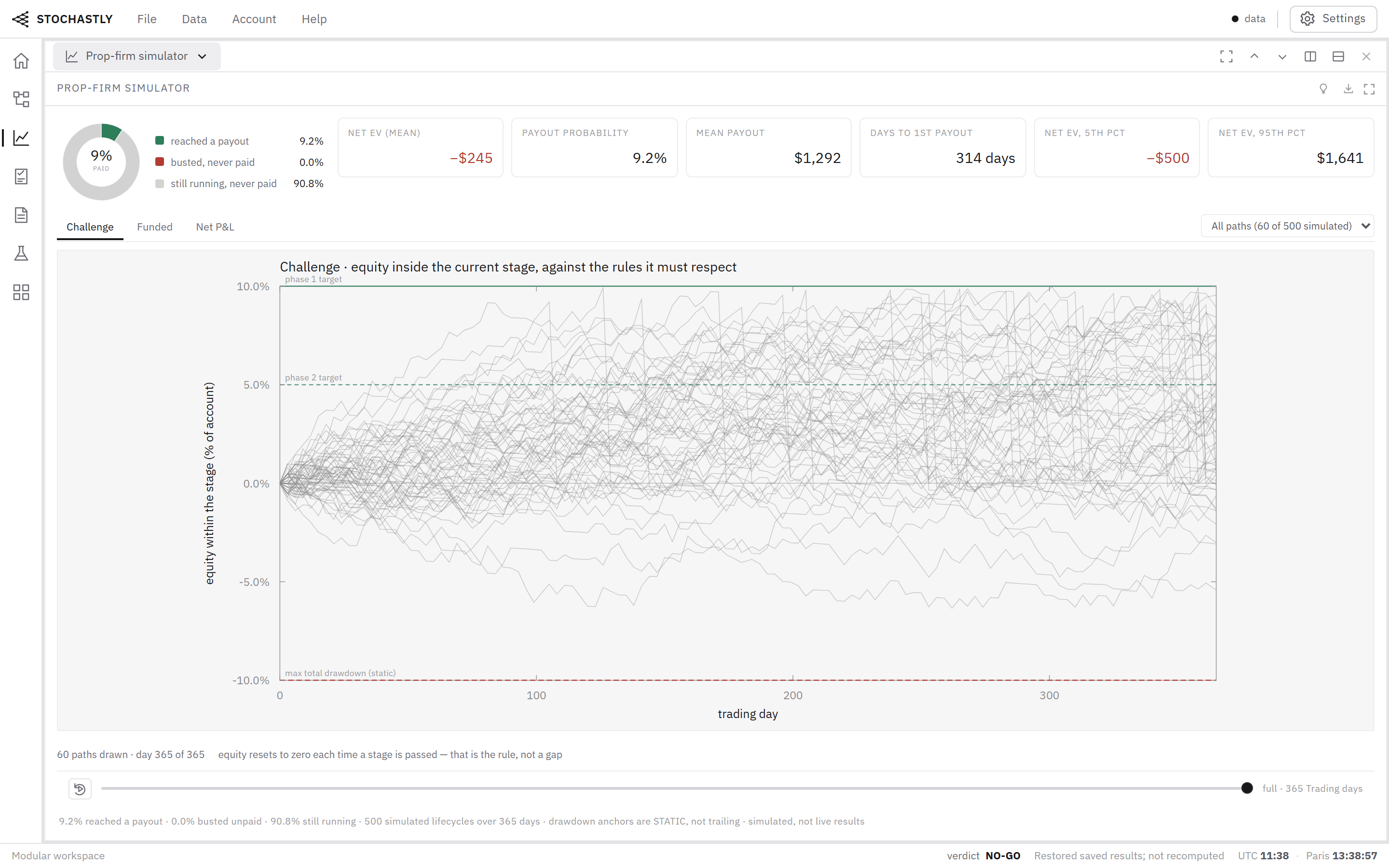
A prop firm evaluation ends at the first rule it touches: the profit target, the daily loss limit or the maximum loss. Its probability of success is a first-passage probability.
Why the average return is the wrong measure
Two strategies with the same average return can have very different chances of passing. The outcome depends on the order of wins and losses: a drawdown early in the evaluation ends it before the expected return has time to appear.
 Open full size
The rules to model
A profit target, a daily loss limit usually measured on equity during the day, a maximum loss from the starting balance or from the peak, and sometimes a minimum number of trading days or a time limit. Each firm words them differently, so they must be read in the firm's own terms.
A daily limit measured intraday can be breached by a trade that closes the day positive, which a daily-close backtest does not see.
“You must satisfy all applicable Trading Objectives concurrently to meet the Evaluation Process requirements.”
Estimating the probability
Replay the strategy's trade sequence under the rules many times, resampling blocks of consecutive trades so that losing streaks are preserved, and record which boundary is reached first. The share of paths that reach the target first estimates the pass probability, and the distribution of days gives the expected duration.
Stochastly models the evaluation this way and reports the probability with the median number of days. It is an estimate from past data; it does not predict a future evaluation.
Frequently asked questions
What percentage of traders pass a prop firm challenge?
Firms rarely publish it, and Stochastly does not quote an industry pass rate it cannot source. It estimates the pass probability of a given strategy from that strategy's own trades under the firm's rules.
Can a backtest guarantee a pass?
No. It estimates a probability from past trades. Market conditions, execution and the firm's rules can differ from the test.
Does position size change the pass probability?
Yes. Larger risk per trade reaches the target faster and also the loss limits faster; at equal aggressiveness, sizing schemes trade speed against the risk of failure.
Sources
FTMO (n.d.). Trading Objectives. ftmo.com.
Politis and Romano (1994). The Stationary Bootstrap. Journal of the American Statistical Association 89(428), 1303-1313.
Bailey and López de Prado (2012). The Sharpe Ratio Efficient Frontier. Journal of Risk 15(2), 3-44.
In the library
Prop-Firm Pass Rates: What Is Actually Known, and What Is Marketing
Prop-Firm Challenges: First-Passage View vs Sharpe
Drawdown Control & the Calmar/MAR Ratio
Related
Prop-firm evaluations in Stochastly
Monte Carlo simulation for trading