Stylized Facts of Asset Returns (Cont's List)
Which empirical features of asset returns must a simulated series reproduce?
Compare a simulated series with the observed sample on return tails, volatility clustering and dependence at several horizons. These are empirical diagnostics for the specified market and period, not universal constants every asset must reproduce exactly.
Stylized facts summarize observed samples and are not universal laws across all markets.
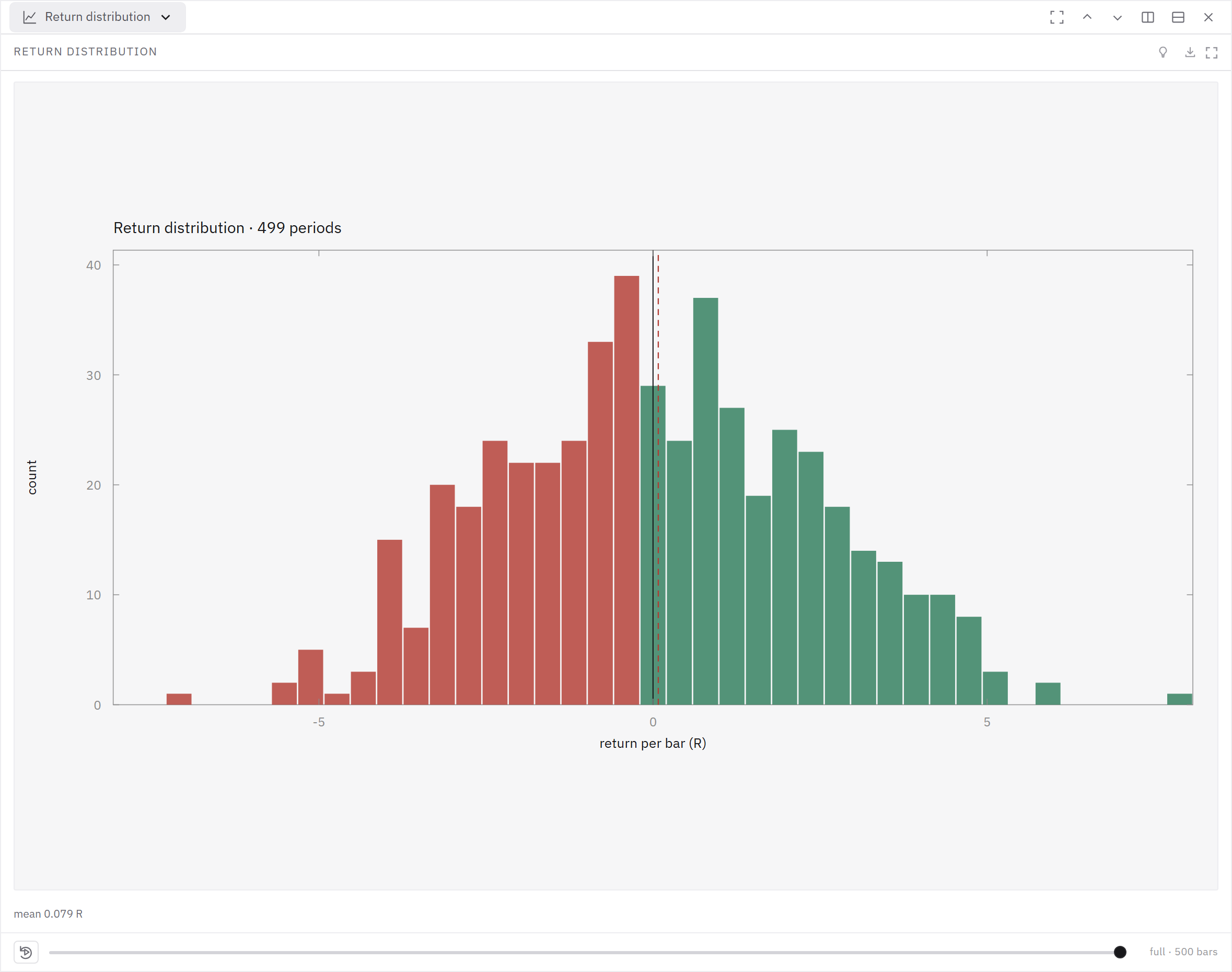
Evidence map
| Aspect | Finding |
|---|---|
| What it is | The catalogue of statistical regularities that returns show across markets, instruments and periods, assembled by Cont (2001) as useful empirical checks for a return model: weak linear autocorrelation of returns beyond very short lags; heavy tails; gain/loss asymmetry; aggregational Gaussianity (the distribution looks more Gaussian as the horizon grows); intermittency; volatility clustering; conditional heavy tails (tails survive GARCH filtering); slow decay of the autocorrelation of absolute returns; leverage effect; volume-volatility correlation; and asymmetry in time scales (coarse-grained volatility predicts fine-grained volatility better than the reverse). |
| Key result / formula | corr(r_t, r_{t+τ}) ≈ 0 for τ beyond minutes, while corr(|r_t|, |r_{t+τ}|) stays positive for weeks to months and decays roughly as a power law with a small exponent. |
| Why it matters for backtesting | Compare the actual series with any proposed null model at the same sampling horizon. |
Key result / formula
Cont illustrates the facts on equity, index and currency series and insists they are qualitative: the tail exponent, the decay rate of the volatility autocorrelation and the horizon at which Gaussianity is reached vary by asset and period and are not universal constants. He also lists the statistical issues that follow — non-stationarity, the poor precision of tail estimates on short samples, and the fact that a stylized fact is a property of the distribution, so it does not pin down a process.
Why it matters for backtesting
A bootstrap that shuffles returns destroys volatility clustering; a Gaussian null ignores heavy tails; either can misstate how unusual the observed backtest is. A strategy using volatility persistence may exploit a documented pattern without establishing directional profit. Measure return autocorrelation, absolute-return autocorrelation and tail behaviour on the actual sample before choosing a simulation law. If a listed pattern is absent, investigate the instrument, period, sampling rule and data quality; its absence alone is neither an error nor a discovery.
Source
Cont, "Empirical properties of asset returns: stylized facts and statistical issues", Quantitative Finance 1(2), 2001, 223-236. Primary source