Sharpe vs Sortino ratio
Should this backtest use Sharpe or Sortino for its stated downside question?
Sharpe divides average excess return by overall return variation; Sortino uses a specified downside deviation. The same return path can therefore score differently, and the downside target and denominator convention must be stated.
Sortino changes with the downside target and denominator convention chosen for the test.
Sharpe scales excess return by total return dispersion. Sortino scales return above a chosen target by downside deviation from that target.
Two denominators
Sharpe counts positive and negative deviations from the mean. Sortino counts shortfalls below the minimum acceptable return, or MAR, while retaining the full observation count in the downside deviation. Neither ratio describes the shape of the losses by itself.
Sharpe = mean(r - rf) / sd(r - rf); Sortino = (mean(r) - MAR) / sqrt(mean(min(0, r - MAR)^2))A four-period calculation
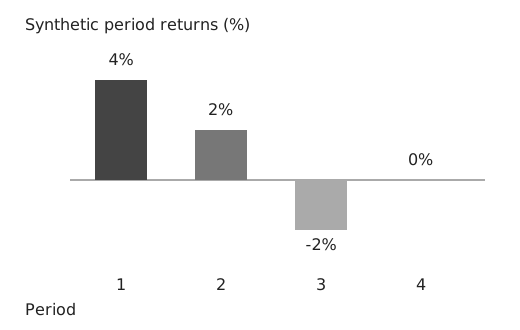
Take returns of 4%, 2%, -2% and 0%, with a zero benchmark return and zero MAR. The mean is 1%. Population standard deviation is sqrt((3^2 + 1^2 + (-3)^2 + (-1)^2) / 4) = sqrt(5) percentage points, giving Sharpe 0.447. Downside deviation is sqrt((0 + 0 + (-2)^2 + 0) / 4) = 1 percentage point, giving Sortino 1. Both ratios use the same four observations and are unannualized.
Reading a backtest
A high Sortino can arise when few sampled returns fall below MAR. State the return frequency, MAR, sampling convention and number of observations before comparing strategies. A strategy with no shortfall has a zero denominator, so its Sortino is undefined or infinite under the stated convention.
In Stochastly
The executor ranks eligible configurations by out-of-sample Sortino and records in-sample and out-of-sample values. A missing finite Sortino remains unranked. Search over many configurations still requires a separate selection correction such as the deflated Sharpe ratio.
Frequently asked questions
Does Sortino ignore gains?
Gains still contribute to mean return. They do not increase downside deviation when they exceed MAR.
Should Sharpe and Sortino use the same target?
Specify the benchmark series used by Sharpe and the MAR used by Sortino. Equal targets make their denominators easier to compare.
Does a larger Sortino prove an edge?
No. Selection over many trials and limited data can inflate either observed ratio.
Sources
Sortino and Price (1994). Performance Measurement in a Downside Risk Framework. Journal of Investing 3(3), 59-64.
Sharpe (1994). The Sharpe Ratio. Journal of Portfolio Management 21(1), 49-58.
Bailey and López de Prado (2014). The Deflated Sharpe Ratio: Correcting for Selection Bias, Backtest Overfitting, and Non-Normality. Journal of Portfolio Management 40(5), 94-107.
In the library
The Sharpe Ratio Can Be Manufactured by Selling Tails
The Standard Error of a Sharpe Ratio, and What Autocorrelation Does to It
Testing That Two Sharpe Ratios Differ (Jobson-Korkie to Ledoit-Wolf)