Why Technical Levels Sometimes Work: the Orders Are Actually There
Do clustered currency orders make technical price levels observable in order flow?
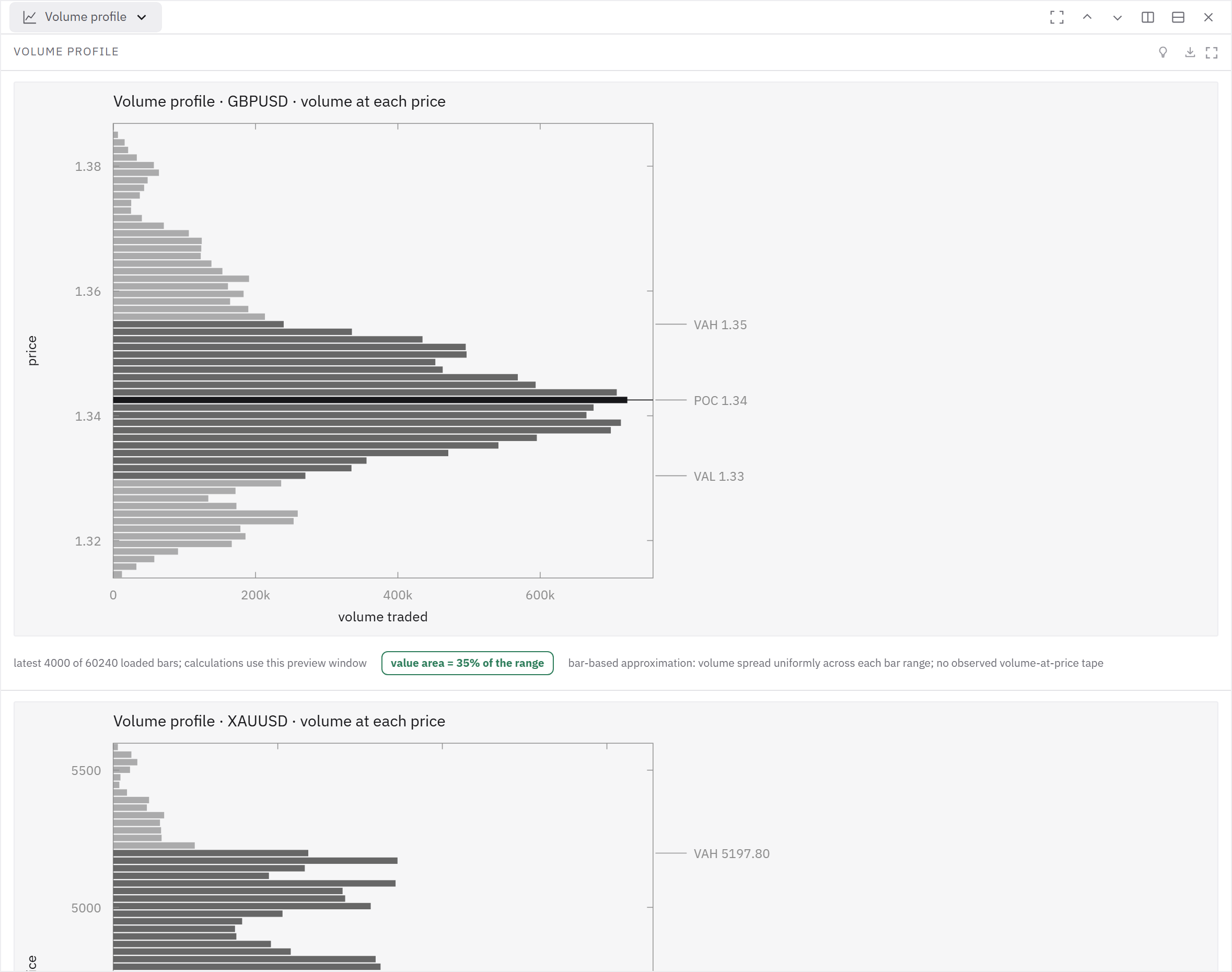
Osler observed conditional orders clustered near round currency prices in a dealer order book. Test price-level behaviour on your own instrument, but traded volume alone cannot reveal stop orders, their intent, or whether the historical dealer pattern persists.
Osler supports order clustering in her FX sample; erosion from manual-placement decline is an unverified hypothesis.
Evidence map
| Aspect | Finding |
|---|---|
| What it is | Osler's explanation for the modest predictive success of two classic technical rules, built on the observed distribution of resting orders in a currency dealer's book. |
| Key result / formula | Using the placement of conditional orders at a large dealer, Osler shows that the two components of technical trading correspond to two features of the order book. |
| Why it matters for backtesting | An agent should use this to reframe a user's question. |
What it is
It is the paper to cite when a user asks whether support and resistance are real.
Key result / formula
First, orders cluster at round numbers, and the clustering is strong enough that the price path around those levels differs systematically from the path elsewhere, producing the bounces that a chart reader labels support and resistance. Second, the arrangement of take-profit orders at the level and stop-loss orders beyond it means that a level which holds tends to hold repeatedly, and a level which breaks tends to break violently, which is the trend-following rule's claim stated in terms of liquidity. The predictive content is real but small, and it is tied to a market structure in which a substantial part of the flow is placed manually at round figures. The paper is careful that this explains the success of the rules, it does not endorse them: the same clustering also explains why the effect erodes as the share of manual order placement falls.
Why it matters for backtesting
Test whether conditional returns depend on proximity to a round number in the instrument and sample. That is measurable on bars: bucket bars by their distance to the nearest round level, compute forward returns per bucket, and compare against a block-bootstrap null. It is also a hypothesis with an expiry date, which makes it a good candidate for a stability check across sub-periods, remembering that a sub-period difference is a detector and not an amplitude (see [A sub-period difference detects a change; it does not measure its size]). Instruments matter: the rounding convention of a currency pair, an index and a crypto pair are different, and a level defined in the wrong units carries no information. Stochastly has no order book, so the mechanism itself cannot be observed here; its shadow in the price can.
Source
Osler, "Currency Orders and Exchange Rate Dynamics: An Explanation for the Predictive Success of Technical Analysis", Journal of Finance 58(5), 2003, 1791-1819. Primary source