Library / Market microstructure
Are Momentum Profits Robust to Trading Costs? The Capacity Question
Do momentum returns survive spread, impact, and turnover costs?
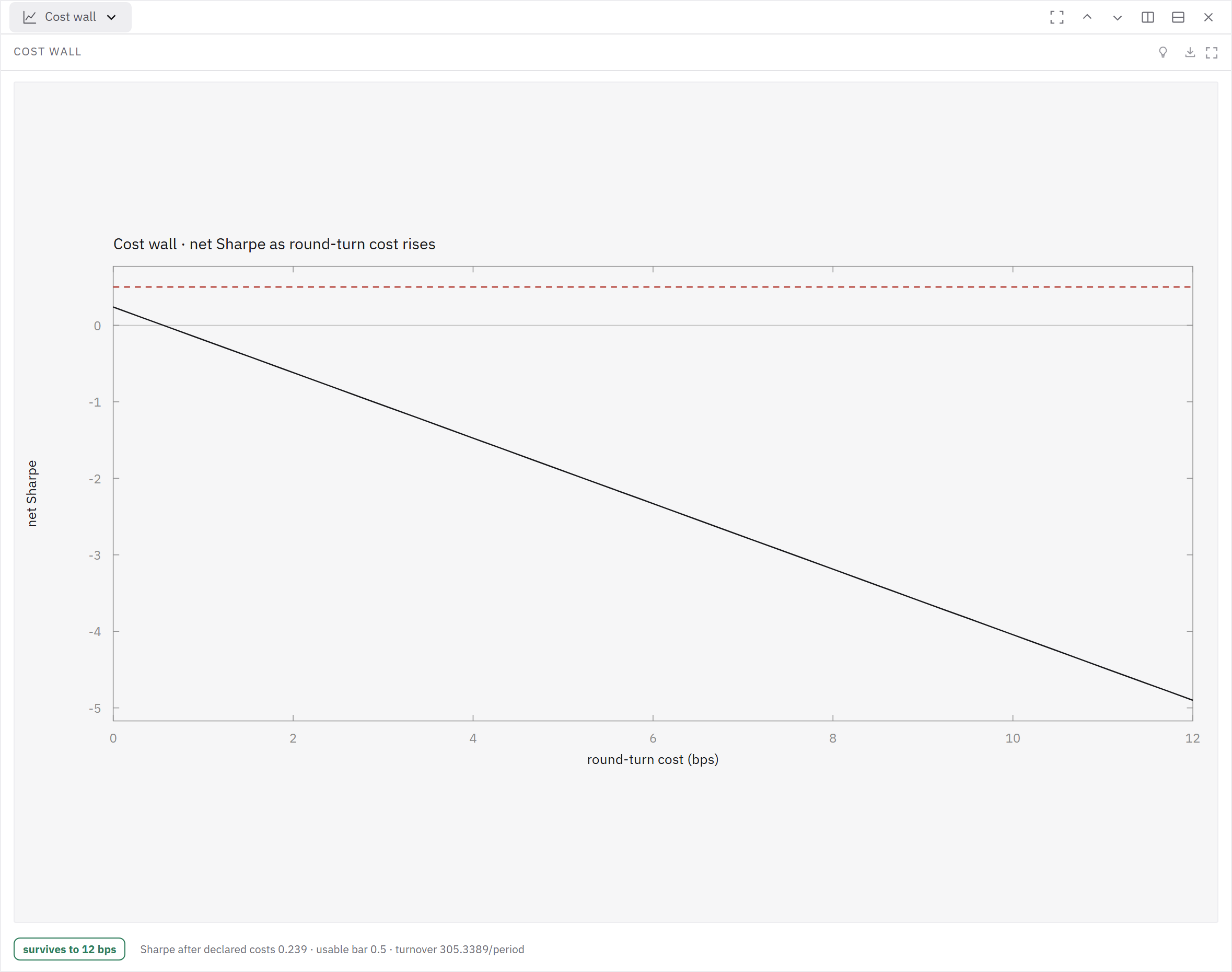
Calculate strategy turnover and apply spread, commissions and size-dependent impact to every rebalance before comparing net returns. The cited capacity estimates use a particular stock sample and December 1999 dollars, so they cannot set a universal capital limit.
Capacity estimates are sample-specific and stated in December 1999 dollars.
Evidence map
| Aspect | Finding |
|---|---|
| What it is | The study that estimates the capital capacity of a documented anomaly. |
| Key result / formula | Momentum requires periodic rebalancing of a portfolio that is, by construction, concentrated in stocks that have just moved, and trading them moves them further. |
| Why it matters for backtesting | Each backtest in Stochastly is run at a size the user chose, and the verdict carries no information about capacity unless capacity is tested. |
What it is
Korajczyk and Sadka estimate the price impact of running a momentum strategy at scale and compute the fund size at which the abnormal return is exhausted by the cost of getting in and out.
Key result / formula
The authors estimate impact functions from intraday data and apply them to the actual portfolio the strategy would hold, which makes the cost depend on the liquidity of the specific names held. The break-even fund size they find is large in absolute terms, in the billions of dollars, but finite, and it depends strongly on how the portfolio is weighted: an equal-weighted implementation, which tilts into small illiquid names, saturates earliest, while weighting toward liquidity raises the capacity substantially at some cost in gross return. The general lesson is that capacity belongs to the implementation of an anomaly, and that the cheapest way to buy capacity is to change the weighting and keep the signal.
Why it matters for backtesting
The test that fits bars is to express the strategy's per-bar traded notional as a fraction of that bar's volume, across the entire sample and per instrument, and read the full distribution: capacity is set by the most constrained days, which are also the days on which the strategy has the most to trade. A strategy whose participation exceeds a small share of volume on its busiest days is not a strategy at that size. The second test is the weighting experiment: rerun with positions scaled by a liquidity proxy such as median volume and compare net results, which is the same trade-off this paper measures. What Stochastly cannot do is estimate the impact function from bars, so the charge remains an assumption, and the capacity number that comes out is an ordering, not a figure to quote.
Source
Korajczyk & Sadka, "Are Momentum Profits Robust to Trading Costs?", Journal of Finance 59(3), 2004, 1039-1082. Primary source