Drawdown Stop-Outs and the Triple Penance Rule
Does a drawdown stop protect capital after accounting for the trades it interrupts?
Simulate the stop rule together with the trades it would interrupt, using the same return path and costs as the unstopped strategy. The published drawdown relation has normal-return and positive-drift assumptions; it cannot set a universal stop distance.
Three-times relation concerns expected maximum quantile loss under stated normal positive-drift assumptions, not arbitrary drawdown.
Evidence map
| Aspect | Finding |
|---|---|
| What it is | The result that recovering from a drawdown takes about three times as long as falling into it, and the associated method for setting a stop-out level from the statistics of the strategy rather than from habit. |
| Key result / formula | Bailey and Lopez de Prado work with a process whose returns have a positive drift and are serially dependent, and compute two quantities for a given confidence level: the maximum drawdown that should be expected, and the maximum time under water, meaning the interval from a peak until the previous peak is recovered. |
| Why it matters for backtesting | The time dimension is the part users are unprepared for and the part Stochastly should surface. |
Key result / formula
The relationship between them is the rule of thumb the paper is named for: under the Brownian case with positive drift, the expected time to recover a drawdown is roughly three times the time taken to incur it, which is why a decline that felt brief is followed by a period of stagnation that feels interminable. The authors also make the point that a stop-out level set without reference to the strategy's own statistics is either so tight that normal variation triggers it or so loose that it provides no protection, and they derive the level implied by a chosen confidence. The result depends on the drift and on the autocorrelation of returns, which must be estimated.
Why it matters for backtesting
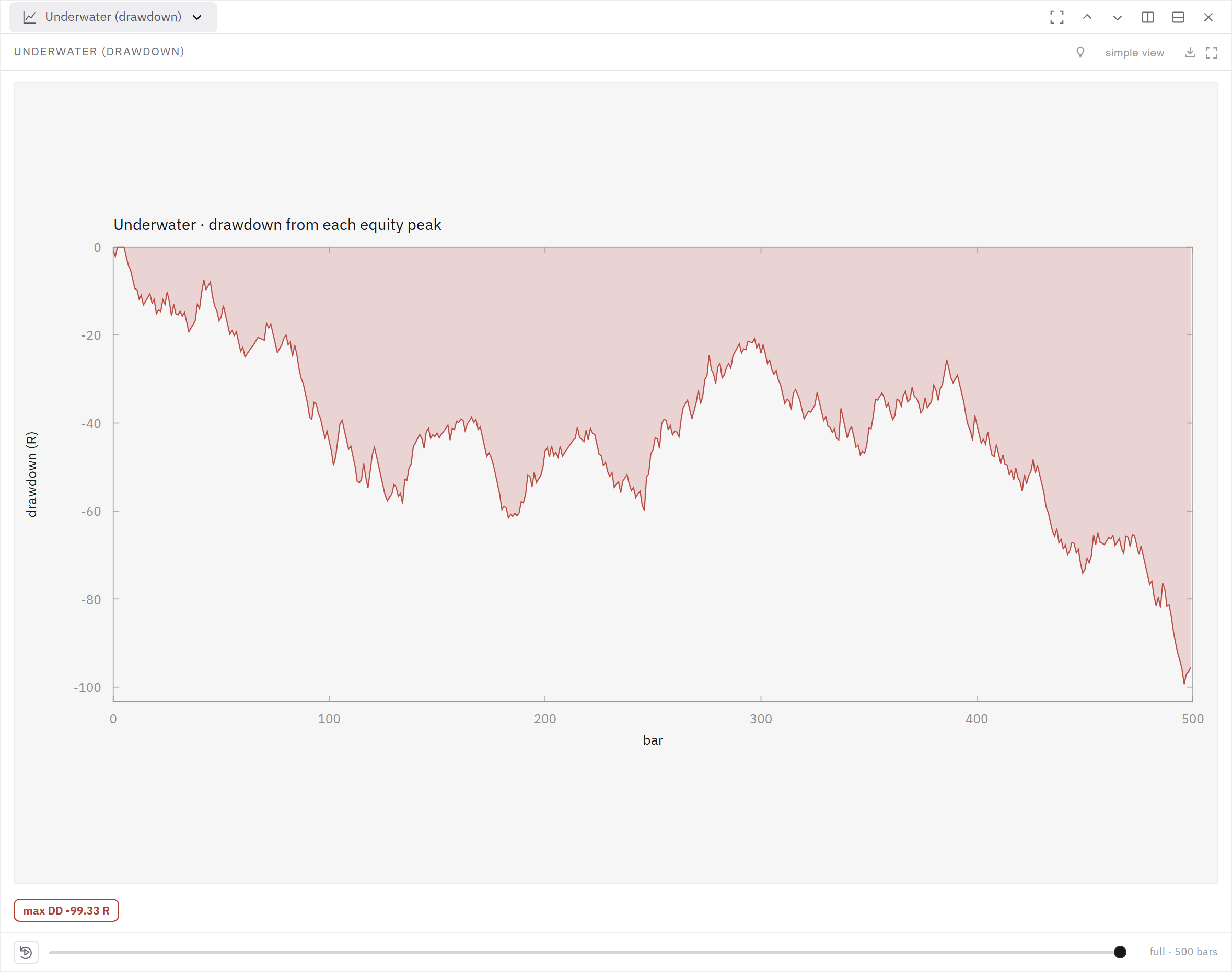
A drawdown chart shows the depth; the quantity that ends careers is the duration, and the triple relationship implies that duration will be several times what the decline suggested. An agent advising on a live strategy should therefore state both the expected worst decline and the expected worst time under water, computed from the strategy's own distribution, before the strategy is started, because after a drawdown begins the same numbers will be read as excuses. The stop-out level follows from the same computation and should be recorded with the verdict, which converts an eventual decision taken under stress into a rule fixed in advance (see [Peeking at Accumulating Data Inflates the Error Rate]).
Source
Bailey & Lopez de Prado, "Stop-outs under serial correlation and the triple penance rule", The Journal of Risk 18(2), 2015, 61-93; circulated earlier as "Drawdown-Based Stop-Outs and the 'Triple Penance' Rule", SSRN 2201302, 2014. Primary source