The Hierarchical Structure of Markets, and What Clustering Adds
What does a market hierarchy reveal that a flat covariance matrix hides?
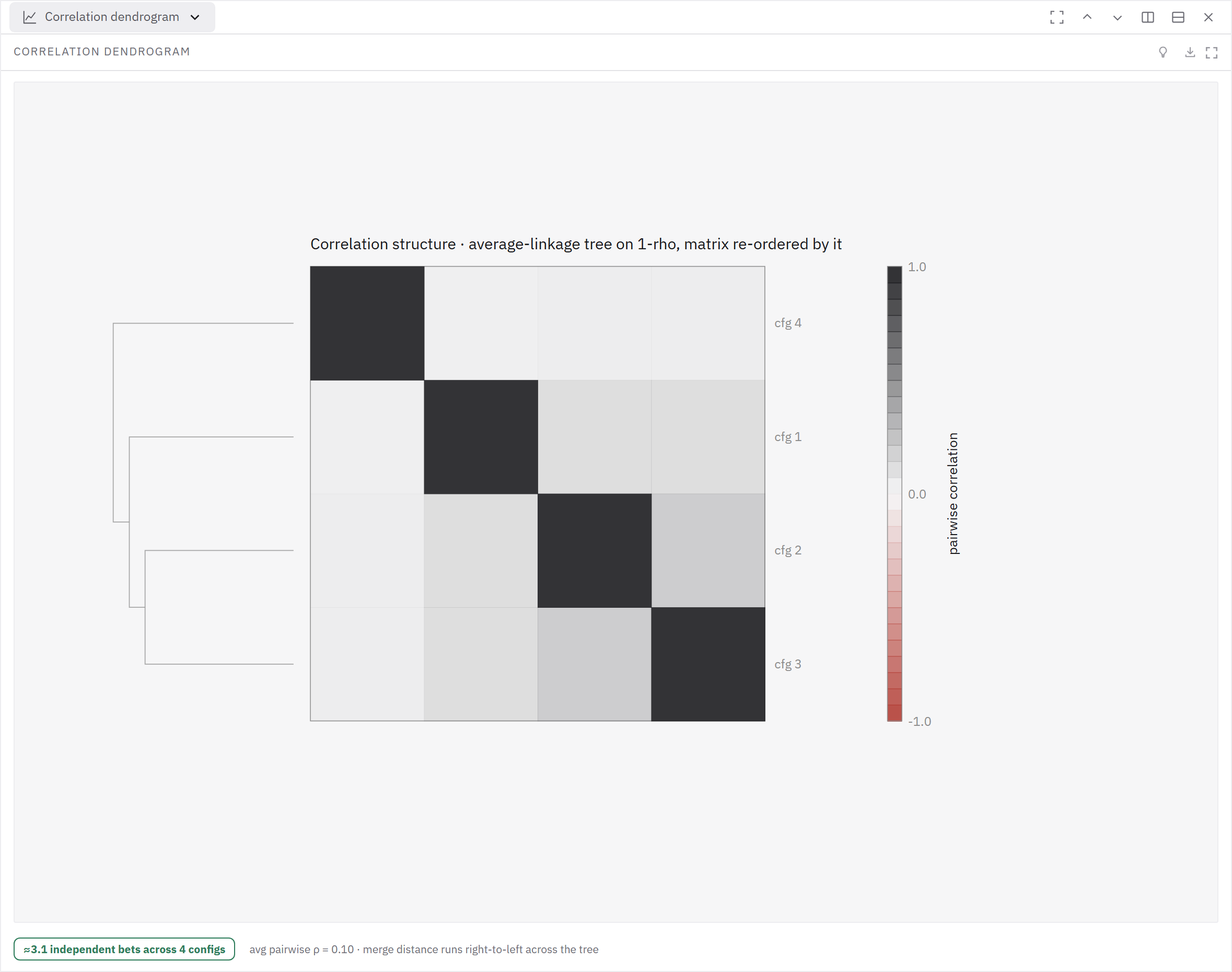
Build a distance from dated correlations and inspect the resulting tree for groups that persist across samples. Mantegna?s observed equity taxonomy describes relationships in that sample; the tree alone cannot prove a covariance matrix is ill-conditioned or that clustered allocation will win.
Mantegna did not establish a causal explanation for ill-conditioned covariance matrices; Raffinot results are limited to his three datasets.
Evidence map
| Aspect | Finding |
|---|---|
| What it is | The origin of the idea that a correlation matrix contains a tree rather than a flat set of relationships, and the comparative evidence on whether allocating along that tree helps. |
| Key result / formula | Mantegna converts the correlation matrix of a set of stocks into a distance, then extracts the minimum spanning tree of that distance. |
| Why it matters for backtesting | Two uses. As a diagnostic, clustering the user's own instruments by return correlation and inspecting the tree can reveal groups of strongly related instruments. |
What it is
Mantegna supplied the structure; Raffinot tested a family of methods built on it. It is the background to [Hierarchical Risk Parity (HRP)], which gives the algorithm.
Key result / formula
The tree is not arbitrary: its branches correspond to economic sectors, which were not given to the algorithm, so the hierarchical structure comes from the return data itself. The studied stock panel yielded a nested economic taxonomy, with groups inside groups. That result does not establish why a particular covariance matrix is ill-conditioned. Raffinot takes the practical step, comparing allocations built on several hierarchical clustering algorithms and linkage choices against each other and against conventional methods on real data. His results favour hierarchical approaches on risk-adjusted measures in the three datasets he tested, while also showing that the choice of clustering algorithm and linkage matters, which means the method carries a design decision that the user must make and that is rarely reported.
Why it matters for backtesting
It cannot by itself establish that positions are economically identical or that the future diversification benefit has a particular size. As an allocation method, the caution is the design decision: the linkage and the distance are parameters, and trying several and keeping the best is a search that must be counted. The defensible practice is to fix the clustering choice in advance on structural grounds, run the allocation out of sample, and compare against the simpler alternatives at equal risk, with no presumption that the hierarchical version wins.
Source
Mantegna, "Hierarchical structure in financial markets", European Physical Journal B 11, 1999, 193-197; Raffinot, "Hierarchical Clustering Based Asset Allocation", Journal of Portfolio Management 44(2), 2018, 89-99. Primary source