Quantitative Risk Management: the Reference Manual
Which assumptions make a quantitative risk calculation useful for a trading decision?
State the loss horizon, position sizes, dependence model and chosen risk measure, then compare predicted loss quantiles with realized exceptions. Expected shortfall summarizes tail severity under its model; a precise number is only as useful as those assumptions.
Expected shortfall is coherent under stated conditions; VaR can fail subadditivity, not in every example.
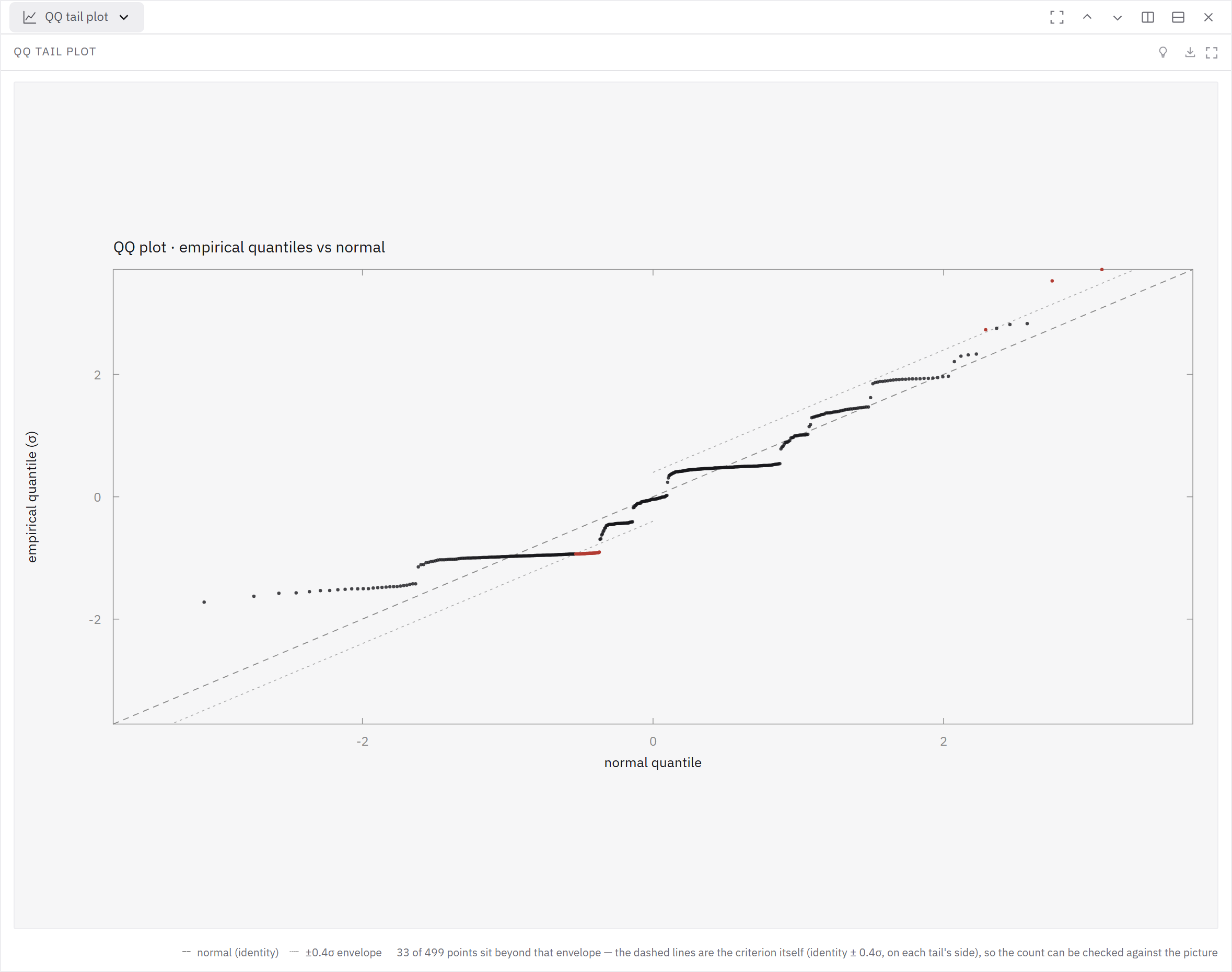
Evidence map
| Aspect | Finding |
|---|---|
| What it is | The standard graduate reference for the mathematics of financial risk, by McNeil, Frey and Embrechts. |
| Key result / formula | Three parts of it are directly useful here. |
| Why it matters for backtesting | An agent asked a risk question that goes beyond Stochastly's built-in measures should send the user here and say which chapter. |
What it is
It is the book to send someone to when the question is what a risk measure assumes, which estimator is appropriate, or how dependence should be modelled beyond correlation.
Key result / formula
The treatment of risk measures sets out the axioms of coherence and shows where common measures fail them: value at risk is not subadditive in general, so the risk of a combined portfolio can exceed the sum of its parts under that measure, which makes it unsuitable for allocating risk across positions, while expected shortfall is coherent and is the measure the book recommends for that purpose. The treatment of extremes develops the limit theorems that justify fitting a parametric tail to the worst observations, the conditions under which they apply, and the estimation pitfalls, including the sensitivity of tail estimates to the choice of threshold. The treatment of dependence separates correlation from dependence properly: correlation is one summary of a joint distribution and a poor one for extremes, copulas describe the dependence structure separately from the margins, and tail dependence measures the tendency of extremes to occur together, which is the quantity that matters for a portfolio and which correlation does not capture.
Why it matters for backtesting
The practical points that transfer are three. Favour expected shortfall over a quantile when combining risks, because the quantile does not add up (see [Tail Risk: CVaR / Expected Shortfall]). Treat a tail estimate as conditional on the threshold chosen and report the sensitivity to it. And do not conclude from a low correlation that two strategies will diversify in a crisis, since tail dependence can be high where linear correlation is low; the test available on bars is to measure the correlation conditional on large moves rather than unconditionally.
Source
McNeil, Frey & Embrechts, Quantitative Risk Management: Concepts, Techniques and Tools, revised ed., Princeton University Press, 2015. Primary source