Why Prices Are a Martingale: Bachelier (1900) and Samuelson (1965)
Under which assumptions should past prices fail to forecast the next price change?
Samuelson?s martingale result applies when price is the conditional expectation of a fixed future payoff under a specified information set and pricing measure. Raw asset prices, risk premia and undiscounted returns need separate assumptions before past prices become an appropriate null.
Samuelson?s martingale result requires a defined anticipated payoff, information set and pricing assumptions; it does not cover every observed asset return.
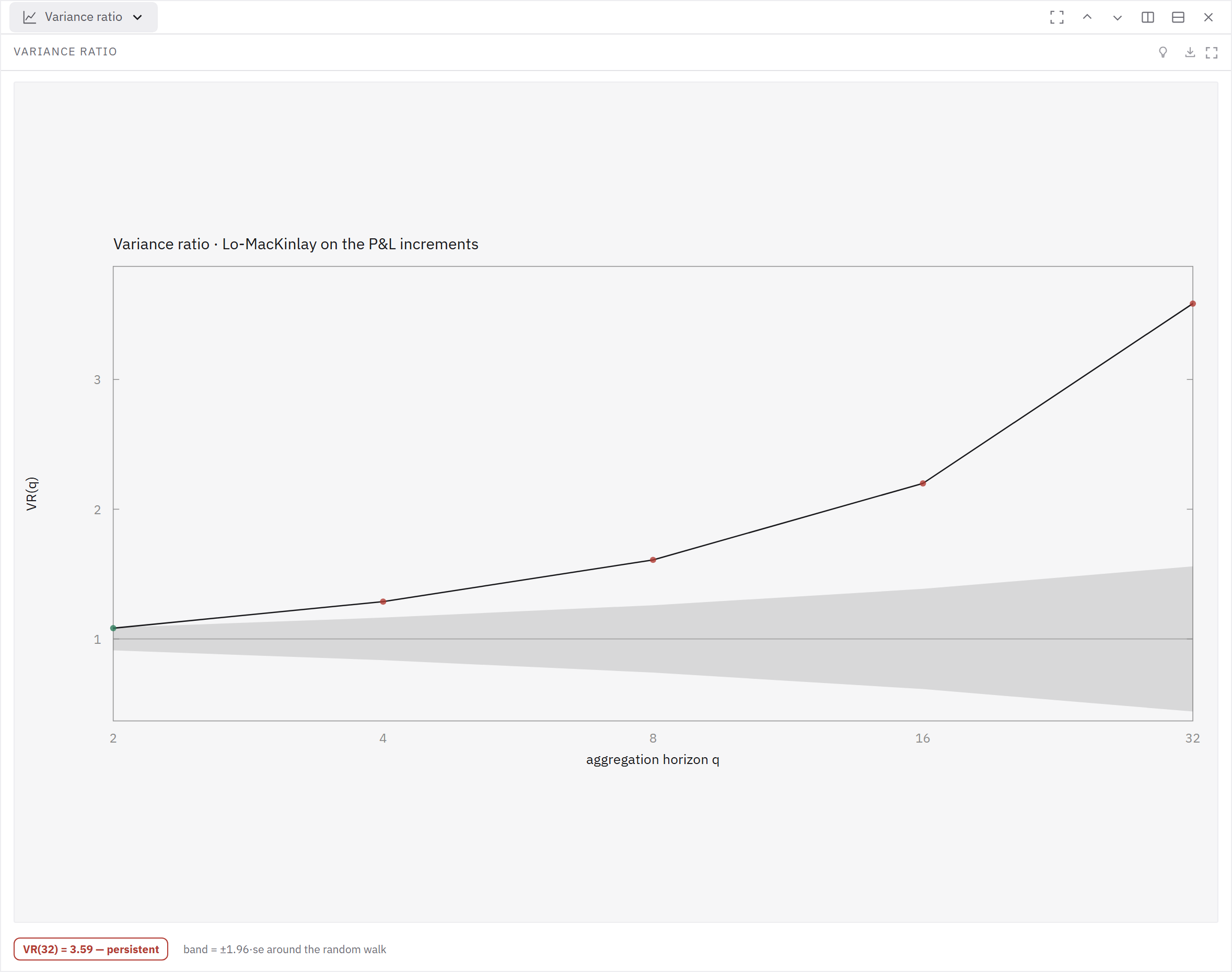
Evidence map
| Aspect | Finding |
|---|---|
| What it is | A conditional-expectation model in which a properly anticipated, suitably discounted claim price has the martingale property under the stated information set. |
| Key result / formula | Bachelier started from the principle that the speculator's mathematical expectation is zero, derived that the spread of prices grows with the square root of time, wrote the diffusion equation for the price density five years before Einstein did for particles, and priced options and the probability of a level being reached before a date. |
| Why it matters for backtesting | Samuelson's result gives a precise benchmark only for a price defined as the conditional expectation of a fixed future payoff under a stated information set and pricing measure. |
What it is
Bachelier's thesis modelled the price of French government bonds on the Paris exchange as a process with independent increments of zero expectation, and Samuelson proved sixty-five years later that "properly anticipated" prices must behave that way whatever the underlying fundamentals do. They provide one useful null for a precisely defined payoff and information set.
Key result / formula
Samuelson's theorem is sharper about why. In a zero-interest idealization, take a fixed future payoff S_T and define today's anticipated price as its conditional expectation given today's information, P_t = E(S_T | I_t). With interest or cash flows, specify the appropriate discounted payoff and pricing measure. Then the sequence of such prices is a martingale, E(P_(t+1) | I_t) = P_t: the expected price change is zero and no function of the information set forecasts it. The spot may mean-revert, follow seasons or trend; the anticipated price does not, because the anticipation already contains that structure. Samuelson insisted the theorem establishes no fact about real markets: it describes what prices look like if they are properly anticipated, not that they are. A martingale is also weaker than a random walk. It constrains the conditional mean alone, so variance can cluster and higher moments can depend on the past without breaking it, which is exactly what bar returns show.
Why it matters for backtesting
It does not assert that every observed asset price, raw return, or trading profit is a martingale; discounting, risk premia and cash flows matter. For a proposed signal, define the payoff and information available at decision time, then compare an after-cost forward-return estimate with a time-respecting placebo and a positive control in development. Evaluate one predeclared sealed batch once. Report the full search history, but do not raise a threshold solely because more levers were tried. A null result with inadequate power is an evidence gap, not proof of a martingale or proof that the strategy has no value. Volatility predictability alone does not prove a conditional mean edge. The sample's bars can also omit information that a different participant can observe.
Source
Bachelier, Theory of Speculation, doctoral thesis, Paris, 1900 (English translation in Cootner (ed.), The Random Character of Stock Market Prices, MIT Press, 1964); Samuelson, "Proof That Properly Anticipated Prices Fluctuate Randomly", Industrial Management Review 6(2), 1965, 41-49. Primary source