Granger Causality Measures Prediction, Which Is Weaker Than Cause (Granger, Pearl)
Does predictive timing establish that one market variable causes another?
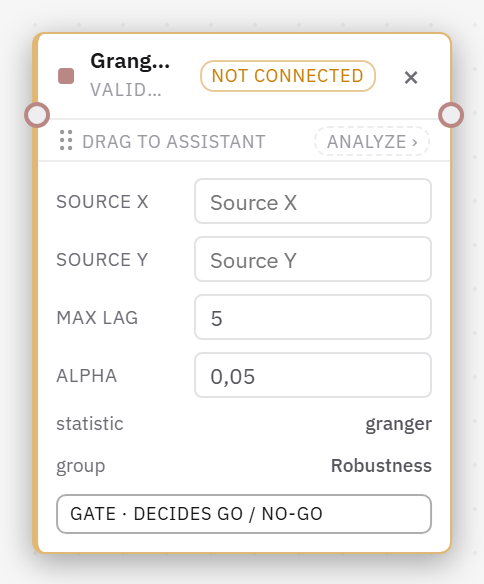
Test whether lagged values of one series improve forecasts of another after conditioning on the specified lagged variables. Passing a Granger test establishes predictive content within that model; omitted variables, shared drivers and intervention effects remain separate questions.
The F test follows model and error assumptions; predictive Granger relation is not intervention causality.
Evidence map
| Aspect | Finding |
|---|---|
| What it is | Granger's operational definition of "causality" between time series, which is a statement about forecastability, set against Pearl's account of what a causal claim actually requires. |
| Key result / formula | Granger's definition: Y causes X if the variance of the optimal prediction error of X_t using all information up to t − 1 is smaller than the variance obtained when Y's past is removed from that information; feedback is the case where both directions hold. |
| Why it matters for backtesting | Each test Stochastly runs is rung one, and that is enough for a forecast: a signal that reduces the error of the forward return is tradable regardless of why. |
What it is
Together they give an agent the vocabulary to say what a backtest can establish (a predictive relation) and what it cannot (what would happen if the signal were intervened on).
Key result / formula
In practice the test regresses X_t on its own lags with and without lags of Y and applies an F-test to the added lags. Granger himself listed the traps: the definition presupposes that all relevant information is available, so a third series driving both X and Y produces "causality" that a fuller information set would remove; apparent instantaneous causality usually means slow recording of one series or a missing variable; and the cross-spectrum can be split into the two directional arms of a feedback relation. Pearl and Mackenzie place this on the first rung of a three-rung ladder: association (seeing, the probability of y given x), intervention (doing, the probability of y given that x is set), counterfactuals (what would have happened had x been otherwise). Granger causality is rung one with a time index. Moving up requires assumptions that no amount of observational data supplies: a diagram of which variables influence which, from which one can tell whether conditioning on a variable removes confounding or, if it is a collider, creates it. Under a confounder the association is real and stable for as long as the confounder persists, and useless the moment it changes.
Why it matters for backtesting
The two errors an agent should name are opposite. One is reading the backtest as rung two, expecting the relation to survive an intervention such as the user's own size in the market or the removal of whatever common driver produced the association. The other is dismissing a rung-one relation because it "is not causal", which is irrelevant to a forecast. On bars the user can run the Granger regression of forward returns on lagged signal values with HAC errors, and, more usefully, the reverse regression of the signal on lagged returns: most technical indicators are deterministic functions of past prices, so they are Granger-caused by returns by construction and the forward test is the one with content. What falsifies a claimed relation is an F-test that does not survive HAC correction and multiplicity, or a relation that exists in levels and vanishes in differences (see [Nonsense Correlations and Spurious Regressions (Yule, Granger-Newbold)]). What Stochastly cannot do is intervene, so rung two cannot be established from bars.
Source
Granger, "Investigating Causal Relations by Econometric Models and Cross-spectral Methods", Econometrica 37(3), 1969, 424-438; Pearl & Mackenzie, The Book of Why: The New Science of Cause and Effect, Basic Books, 2018. Primary source