Slutsky Effect: A Moving Average of Noise Manufactures Cycles
Can smoothing random shocks create cycles that were absent from the raw data?
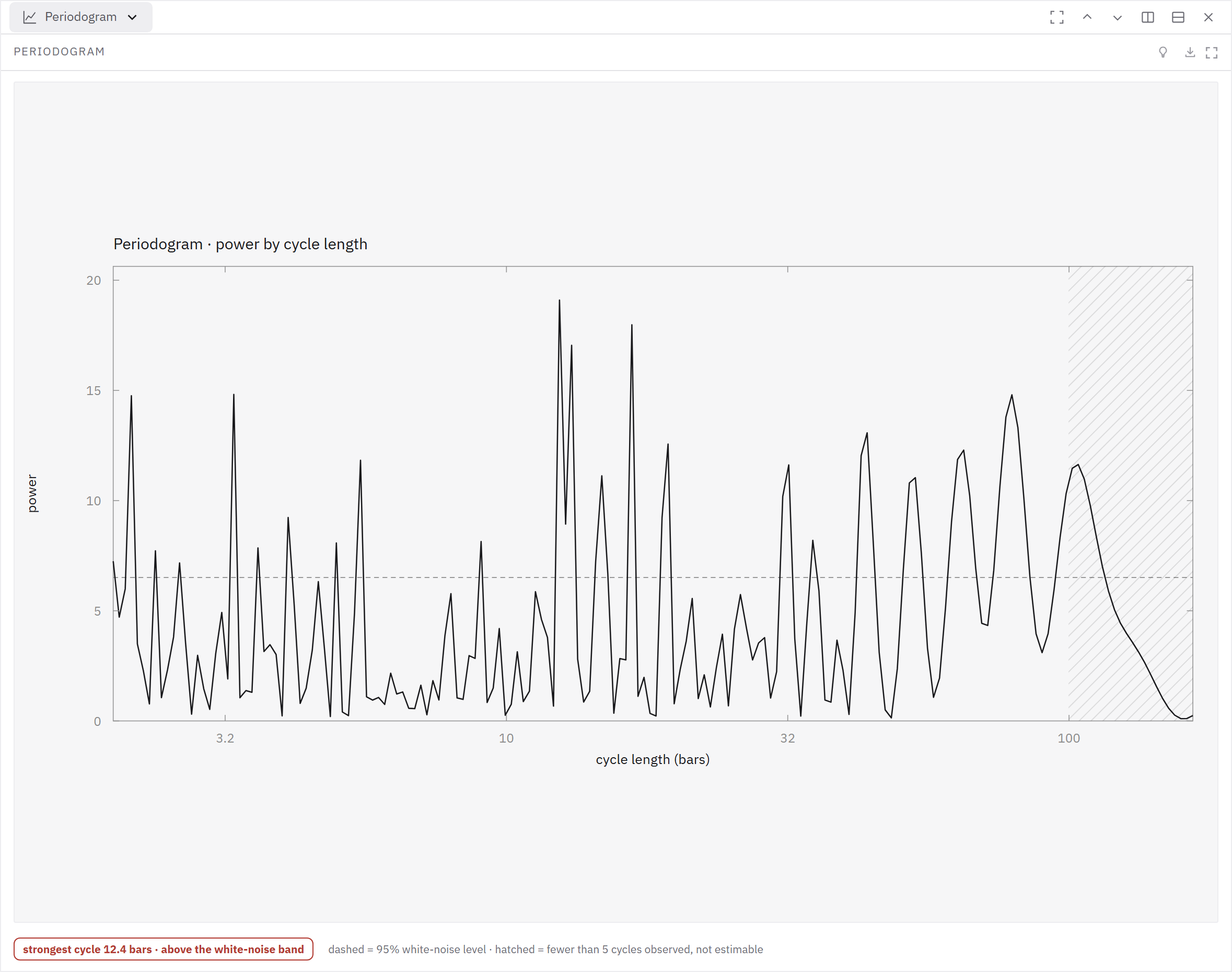
Apply the same smoothing filter to an appropriate noise control and compare its apparent cycle with the filtered market series. Moving averages can create oscillatory looking runs from random shocks; a visible peak needs a calibrated null before interpretation.
Moving-average cycles under a null do not establish an observed strategy edge.
Evidence map
| Aspect | Finding |
|---|---|
| What it is | Slutsky's demonstration that summing or averaging random shocks over a moving window produces a smooth series with apparent cycles, although the shocks contain no periodicity at all. |
| Key result / formula | Take white noise ε_t and form the moving sum y_t = ε_t + ε_(t−1) + … + ε_(t−m+1). |
| Why it matters for backtesting | A simple moving average of returns is exactly Slutsky's y_t; a moving average of prices is a moving sum of a random walk, smoother still; RSI, MACD, stochastic oscillators and crossover systems in general are filters of the same family. |
What it is
The English version appeared in Econometrica in 1937, ten years after the Russian original, and its target was business-cycle theory; its direct victim today is every smoothed indicator a user draws on a chart.
Key result / formula
The output has autocorrelation (m − k)/m at lag k < m and zero beyond, so consecutive values are strongly related, the series drifts in waves whose quasi-period is of the order of the window, and a plot shows peaks and troughs that look like a cycle. Slutsky's theorem goes further: repeated moving summation and differencing drive the series toward a sinusoid, so the "cycle" becomes cleaner the more one smooths. His illustration was to build moving sums of lottery drawings and set the curve beside an index of English business cycles; the resemblance was close enough to make the point that a cycle needs no cyclical cause, and that smoothing of noise suffices. Yule reached a related conclusion by a different route (an autoregression driven by shocks), and the phenomenon is often called the Slutsky-Yule effect. In spectral terms a moving average is a low-pass filter: the flat spectrum of the noise is multiplied by the filter's gain, and what remains is concentrated at low frequencies, which is what a periodicity looks like to the eye.
Why it matters for backtesting
On a pure random walk these filters produce runs, crossovers and "trends" of the window's length, so seeing them on a chart is not evidence that the market has cycles. The test in Stochastly is direct: run the same moving-average rule on the user's real bars and on bars whose returns have been shuffled, which keeps the marginal distribution and destroys any dependence. On the shuffled bars the rule generates the same visual cycles and a distribution of results that is the Slutsky null; the rule has content if the real bars beat that distribution, and not otherwise, and the horizon at which they do should also show up in [Variance Ratio Test (Lo & MacKinlay)] as a ratio away from one. What would falsify a moving-average edge on the user's data is a result inside the shuffled band, with the "cycle" the user saw reproduced in each shuffle. Two things Stochastly cannot fix: a window chosen after looking at the chart is fitted to one realisation of the noise, and the apparent period of the indicator changes with the window, not with the market.
Source
Slutzky, "The Summation of Random Causes as the Source of Cyclic Processes", Econometrica 5(2), 1937, 105-146. Primary source