Position Concentration Risk
Which position can dominate portfolio loss despite a low portfolio-level volatility?
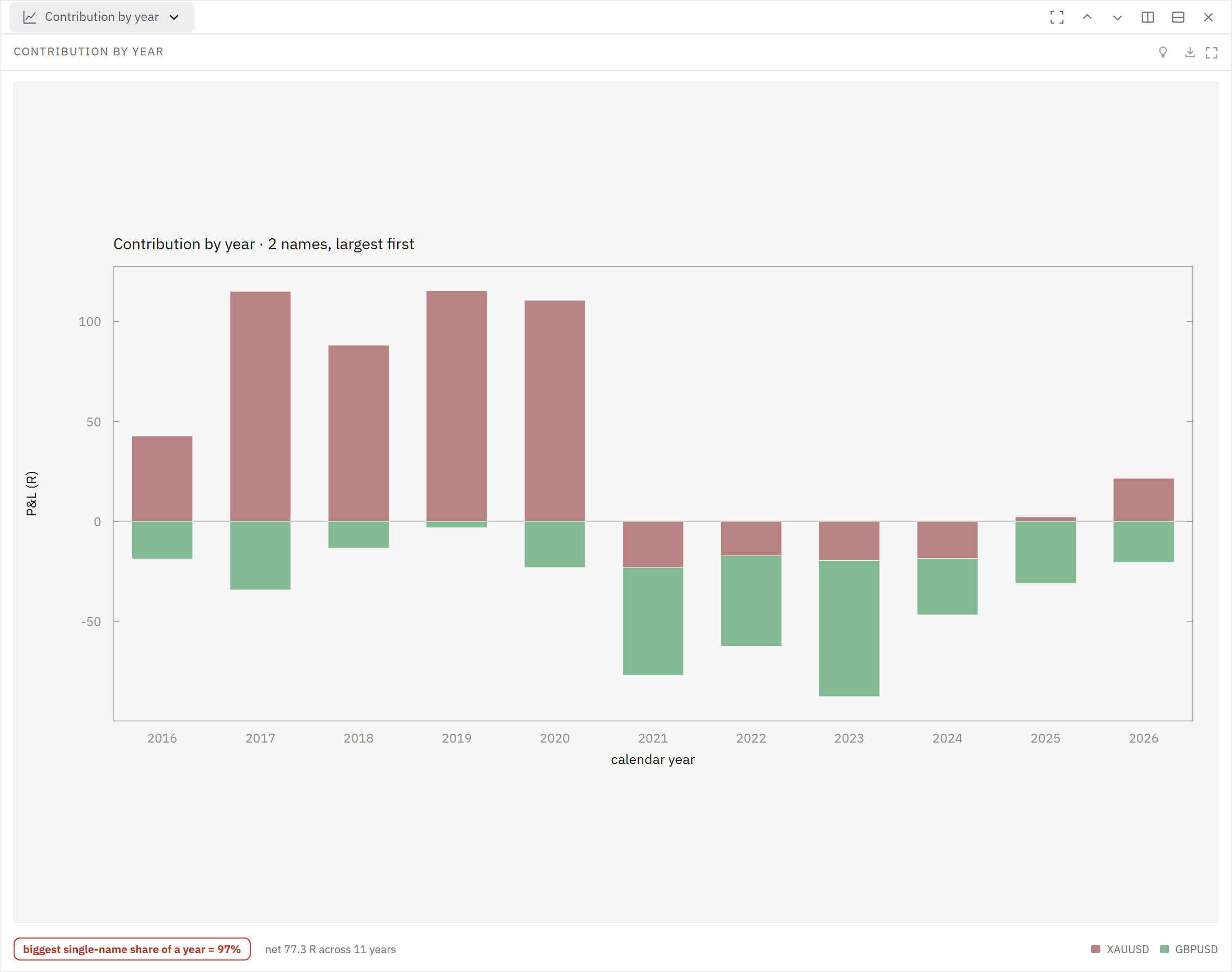
Calculate each position?s weight and its loss contribution under a specified adverse move, then inspect shared factor exposures. Portfolio volatility can look modest while one instrument or factor dominates a tail scenario; the chosen scenario and correlations must be stated.
Four-percent finding concerns US stocks 1926-2016 and net wealth; concentration effects depend on independence.
Evidence map
| Aspect | Finding |
|---|---|
| Idea | Concentrating capital in few positions raises the variance and path-dependence of outcomes and invites blow-up; breadth (many small, weakly-correlated bets) is what converts a real edge into reliable compounding. |
| Key result / formula | Effective number of positions N_eff = 1 / sum_i w_i^2 (inverse Herfindahl) — a book with one dominant weight has N_eff near 1 regardless of nominal count. |
| Practical rule | Cap per-position and per-factor risk, target a minimum N_eff, keep leverage below Kelly, and favour many weakly-correlated small bets over few large ones. |
Key result / formula
Grinold's Fundamental Law of Active Management: IR ~ IC * sqrt(breadth), so the information ratio scales with the square-root of the number of independent bets — concentration can reduce independent breadth when it loads on the same risks. Over-betting past Kelly (f > f*) turns a positive edge into negative expected log-growth. Bessembinder (2018): only ~4% of US stocks generated all net market wealth above T-bills and the median stock lagged cash — extreme positive skew means a concentrated long book easily misses the few winners, while forced concentration in one name carries idiosyncratic ruin risk.
Practical rule
Concentration should be an output of conviction under risk limits, never the default.
Worked exposure
Five positions each at 20% capital look diversified by ticker count. If all five have 0.8 correlation and equal volatility, their effective number of independent bets is much closer to one than five. Inspect factor exposure, sector, venue, currency, funding source and shared stop trigger. A single position can also have nonlinear loss beyond its marked weight when leverage, options or margin calls are involved. Define a concentration limit on the largest position and on the largest shared shock. Stress a 10% simultaneous loss and calculate the resulting portfolio loss before approving size. Historical pairwise correlations are incomplete when tail dependence rises during a crisis. Count joint failure modes, not just holdings.
Source
Grinold & Kahn, "Active Portfolio Management" (2000), Fundamental Law; Bessembinder, "Do Stocks Outperform Treasury Bills?," Journal of Financial Economics 129(3) 2018, SSRN 2900447. Primary source